Omolade Amole
Social Problem – A social condition that undermines the well-being of many people within a society and is often a matter of public controversy.
A lot of conditions undermine the well-being of people , which is why a condition being listed as a social problem is completely relative. Not every problem harms everyone, so not everyone would define the same conditions as social problems.
Another factor that is important to note about social problems is that they vary over time , what was seen as a social problem from 5 years ago could not be looked at in that same light this day. For example, in 1935, Unemployment was one of the most serious social problems because it affected many people but as of 2017 , it was still a social problem, but it wasn’t the most serious one. A more recent example is with the CoronaVirus. This pandemic has disrupted the lives of the majority of the population and continues to till this day. As of this time last year , we would not have called this virus a social problem but with the way it continues to affect lives we can see that it is in fact a social problem.
The next thing to note is this sociological approach known as the social-constructionist approach, which is basically the ‘the assertion that social problems arise as people define conditions as undesirable and in need of change‘. This just emphasizes on the point I made earlier. A social problem is subjective, meaning it is dependent on how people define.
Another thing that is important to note when talking about social problems is the ‘objective and subjective assessment of social issues.’
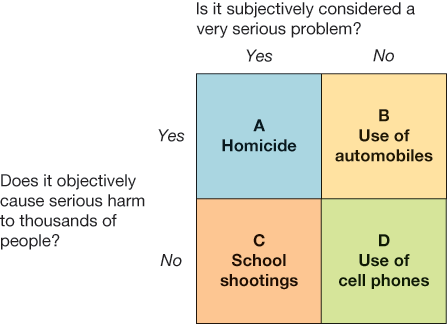
Revel Pearson (Repress-Macionis -8th edition)
Essentially what this figure does is to show how some social problems are perceived, in terms of being subjectively and objectively harmful. It also shows that although some problems can be objectively harmful, they may not necessarily be perceived as social problems. This is not saying that problems in one box cannot change to another box. In fact, one of my main points is the fact that they do change.
Another factor to consider is that for an issue to be a social problem it also must be defined by powerful people because they are the ones that influence the general public opinion. Meaning if an issue is not projected as a social problem by people in power or people with influence, it is not likely to be a social problem. This could be social media, or celebrities or the government.
Another factor to consider for an issue to be a social problem is that claims making must be involved. Claims making is efforts by officials, individuals, and organizations to convince others that an issue or situation should be defined as a social problem (Macionis 1). Meaning that if these groups of people are not actively reinforcing that an issue is a social problem then it is not likely to be one. Claims making usually starts off with a small number of people, then progresses to officials and powerful individuals. Finally, social media publicizes it, increasing the likelihood that issue becomes registered as a social problem. Things such as hashtags, go a long way in emphasizing the severity of an issue, e.g. #blacklivesmatter#MeToo
Then again, claims making does not automatically equate to action being taken. Sometimes these issues only result in change a few years later. Another thing is these claims, garner more public attention . They become more susceptible to counterclaims. Meaning other groups which hold other positions on the issue would be more encouraged to speak up about it. For example, using the Coronavirus pandemic, with the event of this disease occurring, the government has asked us to practice social distancing and we have been put on lock down . But there are still groups of people who do not agree with this lock down saying it interferes with our rights and those people go outside to hold protests based on that.
Something else to note about claims making is peoples ‘deliberate use of language.’. Meaning there is a way two groups of people would talk about an issue dependent on whether they are in support of it or whether they oppose it. One example is young people brought into the country without documentation. People in support of it would call them ‘dreamers’ , but people opposed to it would refer to them as ‘illegals'(Macionis 1). This same language could also be used when trying to create arguments. In the sense that , opponents of a claim would always try to make the other person’s argument look unreasonable.
We cannot talk about social problems without talking about social movements. A social movement is an organized effort at claims making that tries to shape the way people think about an issue in order to encourage or discourage social change. Basically, the next step in claims making is to organize a social movement.
There are 4 stages in social movements:
- Emergence : When people come together, stating that change needs to occur.
- Coalescence : When they begin to make their views public, also engaging in rallies and demonstrations.
- Formalization : When it becomes established in the political scene. Often having employees.
- Decline : When they lose funds or do not gain enough public attention. They may also decline when the aim has been achieved, meaning there is no need for that movement.
Lastly, we cannot talk about social problems without looking at it from a sociological perspective. These are 8 assertions made about social problems by sociologists :
- Social problems result from the way in which society operates : Meaning it is as a result of the way societal institutions are set up.
- Social problems are not caused by ‘bad’ people : Meaning the laws hold individuals accountable for their action, without looking at society’s influence.
- Problems are socially constructed as people define a condition as harmful and in need of change : Which is essentially what claims making is.
- People see problems differently : Defining something as a social problem is also about perspective, some people do not take some issues as seriously as others do, meaning they would not consider them problems.
- Definitions of problems change over time : What is seen as a problem today, may not be a problem next year (this is what we are hoping for with the coronavirus).
- Problems involve subjective values as well as objective facts : This example from Macionis sums this up. Today, about one-third of people who have ever been married have also divorced. But others who think family life can limit individual opportunities, especially those of women, are likely to disagree.
- Many but not all social problems can be solved : Some issues can be seen as bad for some but good for others.
- Various social problems are related : Meaning addressing one problem could solve another problem.
For something to be listed as a social problem , it must pass the following rubrics :
1. Impacts a large number of people
2. Impacts a large number of people
3. Defined by group with influence
4. Caused by social structures
5. Threatens societal values
6. Dynamic/changing
7. Remedied through collective action
8. Impacts many people
 Sociological Approaches to Social Problems